Bevel vs. Chamfer
The difference between a bevel and a chamfer can be confusing. Often, the two terms are used interchangeably in conversation, but there is in fact a difference.
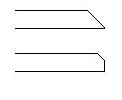
The bevel (above) vs the chamfer (below).
Typically a chamfer only removes a small amount material from the edge of a part. It can be used for removing burrs, aesthetics, or ease of assembly of parts.
Bevels are most commonly used for preparing parts for welding as the bevel removes material across the entire face of the part at an angle. When two beveled parts are aligned, the resulting "V" can be filled with weld metal to produce a quality weld.
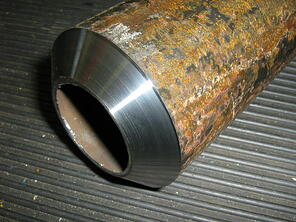 Pipe Beveling Equipment
Pipe beveling can be completed by hand, but hand beveling is by far the least efficient way to bevel a pipe. Pipe beveling machines are far faster than other methods like hand grinding, flame cutting, hand held bevelers, or loading into a lathe. They are also much cleaner and safer than hand grinding or torching because all of the chips and debris is contained within the pipe beveling equipment.
Typically, pipe beveling equipment has a cycle time of 5 to 20 seconds and can deliver consistently accurate bevels, one of the most important features of a pipe beveling machine. Another important feature of pipe beveling equipment is that it typically has low operation costs and can usually be operated by a non-skilled operator once the machine has been setup.
Finding a Pipe Beveling Machine
MSI is located in Beaumont, TX and builds chamfering and pipe beveling machines, marking equipment, bar shears, nut assembly tables, cylindrical parts feeders, bolt cross drills, and bolt shortening tools and services an international customer base in a variety of industries.
MSI offers a wide range of pipe beveling equipment to suit almost any need and industry. Check out all of ChamferMate pipe beveling equipment we carry to find the right pipe beveling machine.